Introduction: Finding meaning
Most applications still search the way a filing cabinet does. You type a word, the database looks for that word, and you get back rows that contain it. In Rails that usually means ILIKE, a tsvector column, Elasticsearch, or a hosted search product. Those tools are excellent when the user already knows the title, the author, or a distinctive phrase.
They fall apart the moment the query is a description of intent.
A reader who types “hopeful sci-fi” does not want books whose blurbs literally contain those two tokens. They want stories that feel like hope in a future setting - books that might talk about “found family among the stars,” “a colony that learns to trust again,” or “optimism after collapse.” Full-text search cannot make that leap. It has no notion of synonymy, mood, or paraphrase. If the keywords are missing, the book is missing.
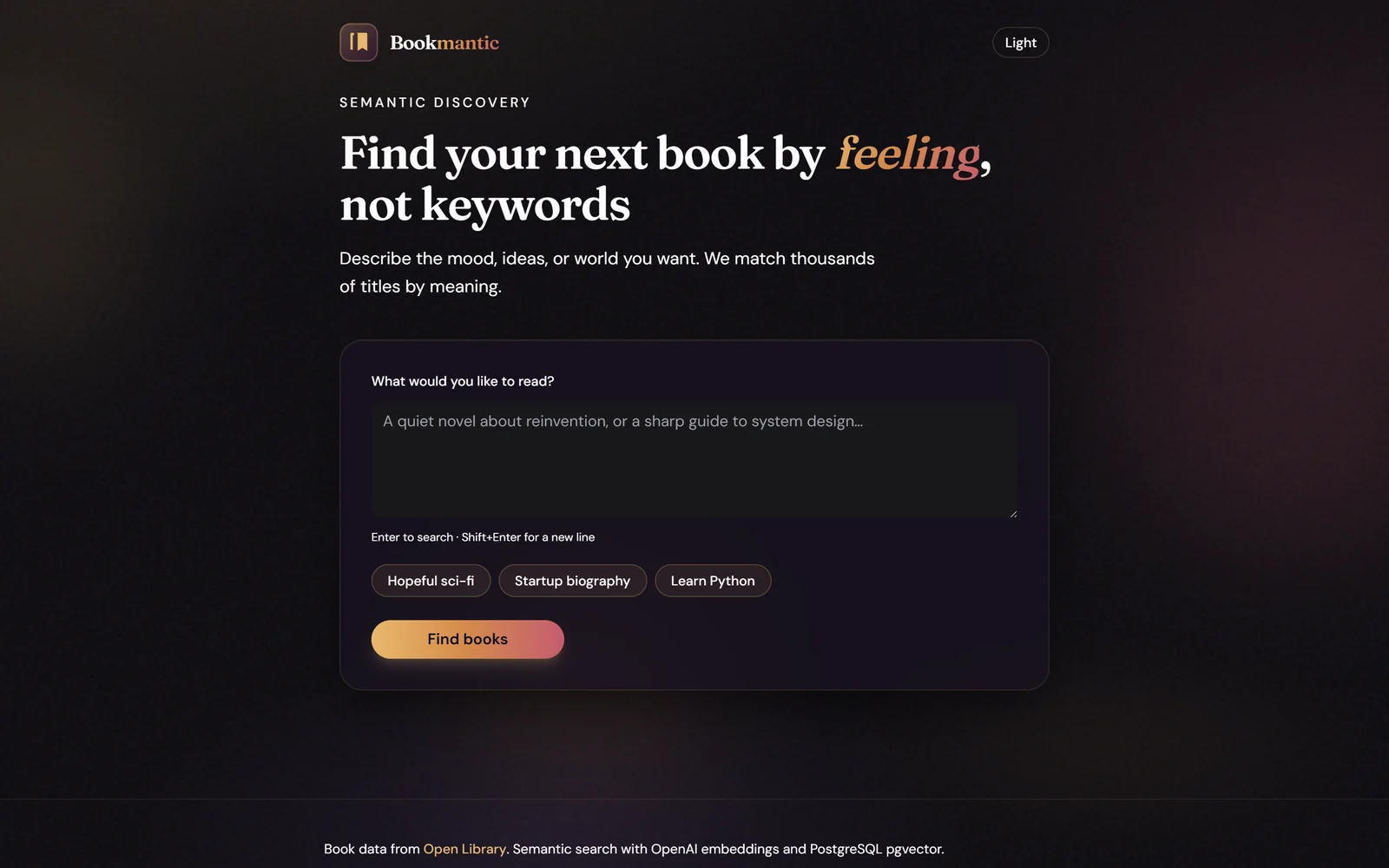
That gap is why I built Bookmantic: a small discovery app where you describe what you want to read, and the catalog answers by meaning rather than by string match. Under the hood it is a Rails 8 API, PostgreSQL with pgvector, Andrew Kane’s neighbor gem, and OpenAI text-embedding-3-small embeddings. The source lives in github.com/noplisu/bookmantic.
This case study walks through that stack: why semantic search, how it lands in Rails without blocking web requests, how the book catalog was built, what the results actually look like, and why this retrieval layer is a natural base for RAG later.
Implementing semantic search in Rails
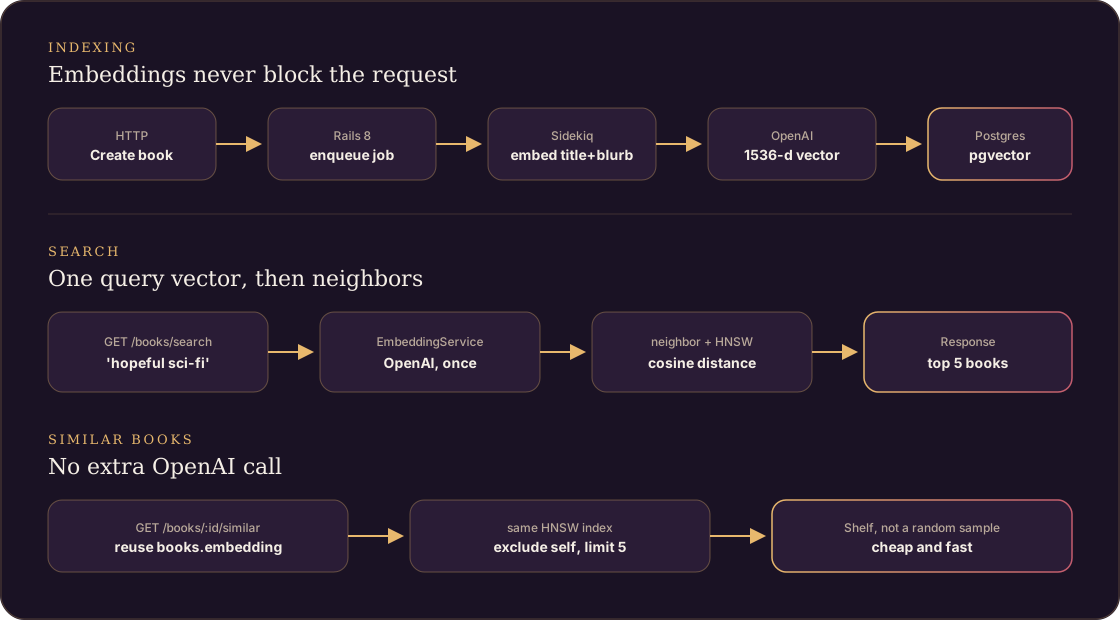
The first working slice was a proof of concept: embed some text, store a vector, query by cosine distance. That vector search POC indexed sample articles. The production shape is the same idea applied to books.
The moving parts are deliberately few:
- A
Bookrow holdstitle,url,description, optionalgenresandcategory, and a nullableembedding vector(1536). - A Sidekiq job is the only writer of embeddings. Creating a book enqueues work; the HTTP request never calls OpenAI.
- Search embeds the query once, then asks Postgres for nearest neighbors.
- “Similar books” reuses the stored vector, so that endpoint does not hit OpenAI at all.
The model and the index
Neighbor adds a has_neighbors declaration. The interesting part is the column type and the index. ActiveRecord still does not dump vector cleanly into schema.rb, so the app uses config.active_record.schema_format = :sql and db/structure.sql.
class Book < ApplicationRecord
  has_neighbors :embedding

  validates :title, presence: true
  validates :url, presence: true
  validates :description, presence: true

  after_create_commit :enqueue_embedding_generation,
    unless: -> { ActiveModel::Type::Boolean.new.cast(ENV["DISABLE_EMBEDDING_CALLBACKS"]) }

  private

  def enqueue_embedding_generation
    GenerateEmbeddingJob.perform_later(id)
  end
end
The HNSW index uses cosine ops, matching the metric used at query time. At ~45k rows, exact nearest-neighbor in Postgres would still be acceptable. HNSW is the default I would keep as the catalog grows: more memory and a slower build than a sequential scan, no IVFFlat training step, and no index swap at the next order of magnitude.
ALTER TABLE books ADD COLUMN embedding vector(1536);

CREATE INDEX index_books_on_embedding_hnsw
  ON books
  USING hnsw (embedding vector_cosine_ops);
Choosing an embedding model
text-embedding-3-small at 1536 dimensions is the boring, correct choice for an MVP. It is cheap, fast, and good enough that catalog quality dominates model quality. A larger model would not rescue a dump full of dictionaries, large-type reprints, and empty descriptions.
The service is a thin wrapper around ruby-openai. It truncates oversized Open Library blurbs so a single outlier description cannot fail the job:
class EmbeddingService
  MODEL = "text-embedding-3-small"
  DIMENSIONS = 1536
  MAX_EMBED_CHARS = 50_000

  def self.embed!(text)
    input = text.to_s.strip
    raise Error, "Text to embed is empty." if input.blank?
    input = input[0, MAX_EMBED_CHARS] if input.length > MAX_EMBED_CHARS

    response = client.embeddings(
      parameters: { model: MODEL, input: input, dimensions: DIMENSIONS }
    )

    vector = response.dig("data", 0, "embedding")
    raise Error, "No embedding vector in OpenAI response." if vector.blank? || vector.size != DIMENSIONS
    vector
  end
end
The job concatenates title, description, category, and genres. That mix matters: a short synopsis plus subject tags gives the vector both plot and shelf.
def perform(book_id)
  book = Book.find(book_id)
  parts = [book.title, book.description]
  parts << "Category: #{book.category}" if book.category.present?
  parts << book.genres if book.genres.present?
  vector = EmbeddingService.embed!(parts.join("\n\n"))
  book.update_column(:embedding, vector)
end
update_column skips callbacks so storing the vector cannot re-enqueue the job. Seed and bulk import set DISABLE_EMBEDDING_CALLBACKS and enqueue (or skip) jobs explicitly.
Search and similar
Search is one embedding plus one neighbor query. Books without a vector are excluded so a half-finished Sidekiq queue cannot pollute results:
query_vector = EmbeddingService.embed!(q)
books = Book
  .where.not(embedding: nil)
  .nearest_neighbors(:embedding, query_vector, distance: "cosine")
  .limit(5)
Similar books skip OpenAI and compare against the stored vector. If that column is still null, the API returns 422 instead of guessing:
books = Book
  .where.not(id: book.id)
  .where.not(embedding: nil)
  .nearest_neighbors(:embedding, book.embedding, distance: "cosine")
  .limit(5)
That split is the whole product loop: describe a mood to enter the catalog, then walk sideways through neighbors. The Rails side of Bookmantic is small on purpose. Most of the work is elsewhere—in the data.
Preparing the data
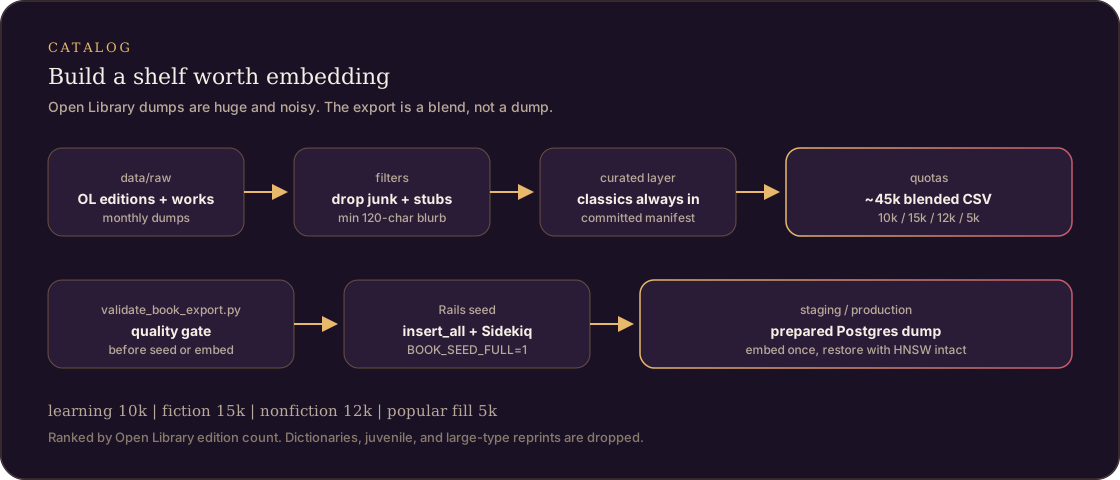
Vector search is only as interesting as the documents you embed. Open Library’s monthly dumps are enormous and uneven: millions of editions, duplicate works, juvenile reprints, dictionaries, and records with no usable description. Indexing “everything” would have been expensive and, worse, noisy.
The pipeline lives under data/ and scripts/:
- Download the editions and works dumps into
data/raw/. - Resolve a committed curated manifest of classics and learning anchors into full rows with descriptions.
- Export a blended ~45k CSV with genre quotas.
- Validate before seed or embed.
Ranking by edition count is a cheap popularity proxy. It is not a quality score, but it prefers books people actually publish and reprint over one-off catalog noise. Quotas stop the catalog from collapsing into whatever the dump happens to contain most of.
After validation, Rails seeds from data/processed/books_top45k.csv. Development loads 200 rows by default; BOOK_SEED_FULL=1 loads the lot and enqueues embedding jobs. For staging and production, embeddings are generated once locally, then shipped as a Postgres dump (bin/db-dump / bin/db-restore). That avoids paying OpenAI again on every deploy and keeps HNSW indexes intact.
The lesson from this stage is blunt: the ETL is the product. A clever neighbor query over junk is still junk.
The Results: finding books by meaning
Once the catalog is embedded, queries start to behave like conversation instead of grep. Here is what that looks like with real rows, not a vibe.
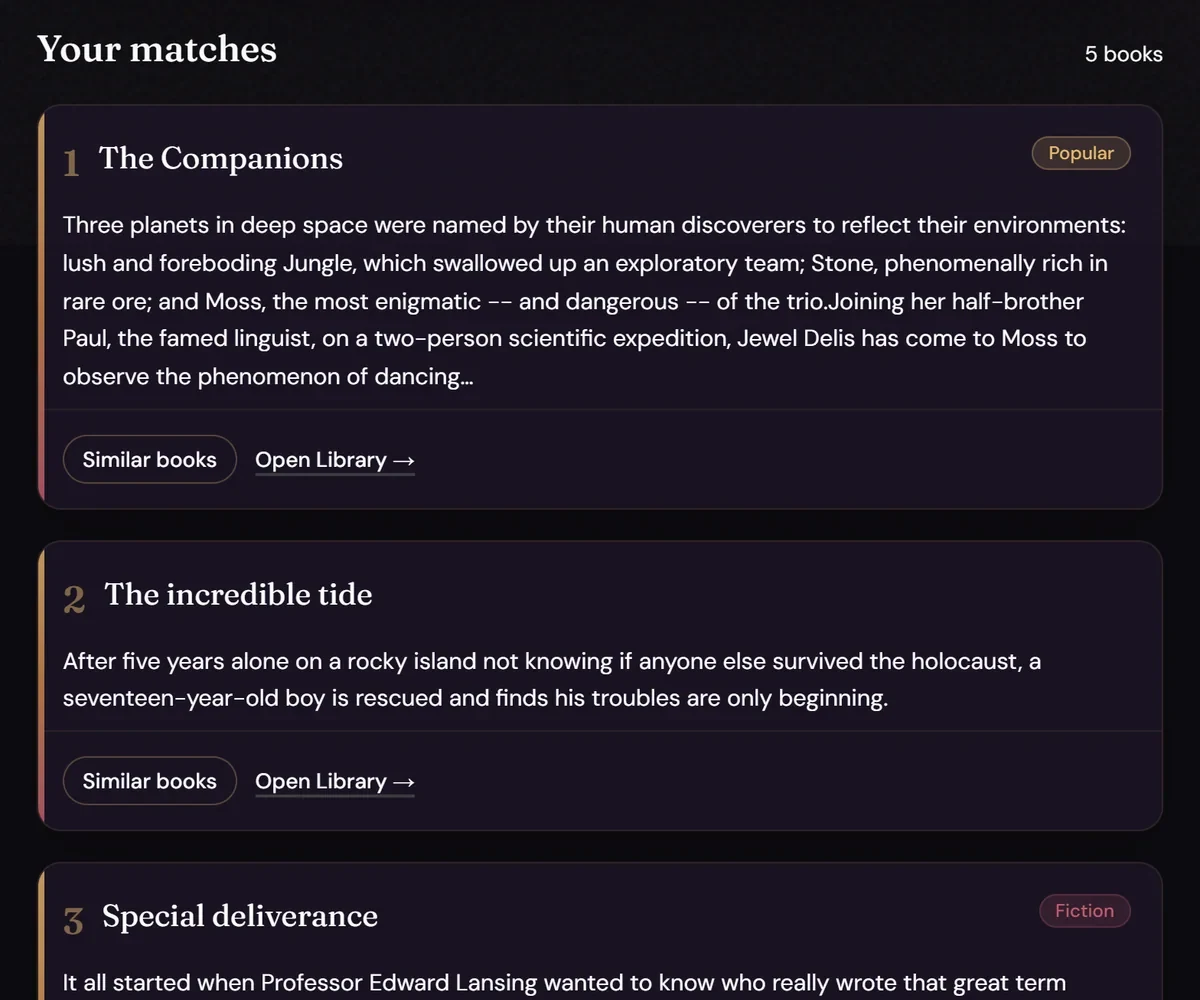
A chip on the homepage turns “hopeful sci-fi” into hopeful science fiction about friendship and discovery. Keyword search would hunt for those tokens. Neighbor search returned:
- The Companions — planets named Jungle, Stone, and Moss; companionship is the plot, not a synonym stuffed into the blurb.
- The incredible tide — a boy on a rocky island after a holocaust; survival with an undercurrent of rebuilding.
- To Be Taught, If Fortunate — somaforming and exoplanets; the optimism lives in the science, not the title.
The Startup biography chip expands to biography of a technology founder building a company and lands on Founders at Work, Becoming Steve Jobs, and Anything You Want—none of which need the word startup in the blurb. Type only “startup biography” and you still get founder stories, plus LinkedIn Profile Optimization for Dummies: career-adjacent, not a life. A longer prompt is a better document. Semantic recall gives you the shelf; prompt length decides how much junk sits next to it.
Similar-book pages are the second test. Clicking through from a hit should feel like a shelf, not a random sample. Because that path uses the stored vector, it is also cheap: no extra embedding call, just HNSW over ~45k rows.
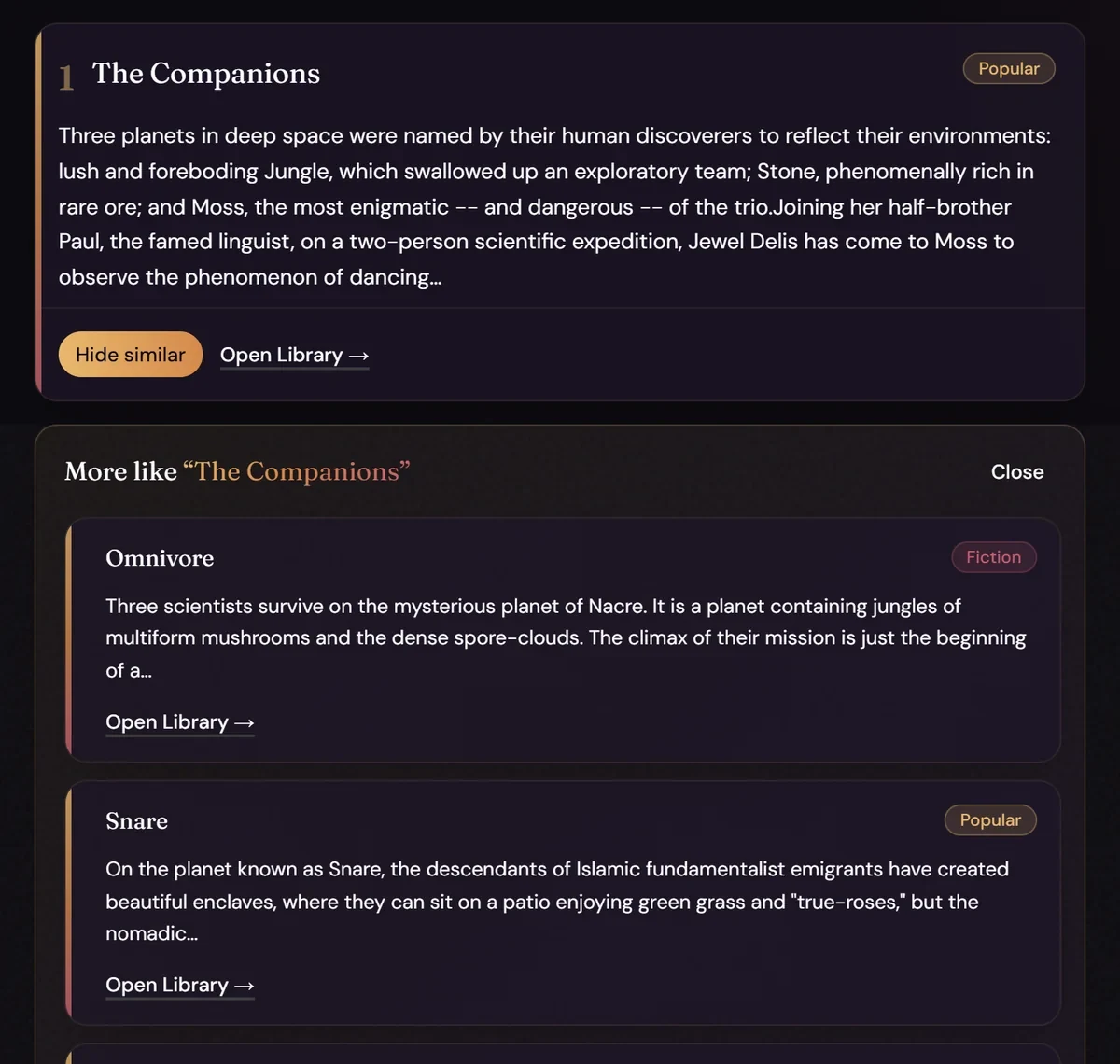
From The Companions the neighbors are other planetary-adventure novels: Omnivore, Snare, The howling stones, Ally, The skinner. Distances there are tighter (about 0.32–0.35) than query-to-book. A stored book vector is a richer document than a short prompt, so sideways walks are usually cleaner than the first search.
Distance is exposed in the JSON as cosine_distance and cosine_similarity. Lower distance is closer. I do not show raw scores in the UI as a ranking explanation—readers do not think in cosine—but they are useful when tuning what “close enough” means.
The instructive miss is an identifier. Searching the ISBN 9780141439518 (a Penguin Pride and Prejudice) returns unrelated nonfiction at distance ~0.60: noise, not a near miss. The one-letter query “a” is the same shape. Type the title pride and prejudice and the book comes back, because that string lives in the description. Semantic search is strong at vibe and weak at exact lookup. That is the next design constraint, not a reason to throw vectors away.
You can try it live at bookmantic.com.
Lessons Learned
Data quality beats model upgrades. Cleaning Open Library, enforcing description length, and blending curated classics did more for relevance than swapping embedding models would have. Garbage in embedding space is still garbage, only harder to debug.
Keep generation off the request path. Embedding 45k books is a queue, a rate limit, and a bill. Search only needs one query vector. Similar books need zero. Sidekiq plus update_column keeps the API snappy and the OpenAI client in one place.
Cost is mostly the backfill. At OpenAI list prices, embedding ~45k short documents with text-embedding-3-small is a few dollars, not a few hundred. The expensive parts are wall-clock time (one Sidekiq job per book, plus rate limits) and a ~300MB Postgres dump so production never repeats that work. In production, search is about 0.3–1.5s, almost all of it the query embedding. Similar books skip OpenAI and return in under 100ms. Re-embedding the catalog because you changed the input recipe is the bill you actually want to avoid.
Vector search is not a full search product. Exact titles, author names, and identifiers still belong to lexical search. The useful end state is hybrid: keyword for precision, vectors for recall and mood, then a simple merge. Bookmantic is honest about being the semantic half first. Connecting the two is the obvious next improvement, not an afterthought I pretend is already done.
Stay inside Postgres until you must leave. pgvector plus HNSW is enough at this scale. Exact kNN would still answer in time at 45k; the index is a habit for the next size up, not a requirement to make the demo work. A dedicated vector database would have added ops without changing the user-visible result.
Conclusion
Bookmantic started as a question: can a Rails app let someone find a book by describing a feeling? The answer is yes, if you treat embeddings as a column, neighbor search as a query, and catalog construction as the hard part.
The same retrieval path is a base for RAG later: five real neighbors in, a recommendation out, instead of a model inventing titles. Retrieval without generation already works.
If you are adding semantic search to an existing Rails app, start smaller than a 45k dump: one model, one HNSW index, jobs instead of callbacks, and a dataset you have actually read. The vectors will do their job. Your job is to give them something worth finding.
The code is on GitHub. The running catalog is at bookmantic.com.